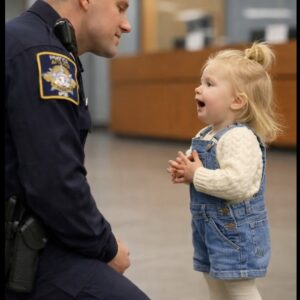
In the days after, the town moved more carefully, as if every turn of the wheel carried a memory. People paused at intersections without knowing why, feeling the ghost of a moment when everything could have ended differently. The crash site was cleaned, but in the minds of those who’d heard the impact, it remained a permanent landmark, mapped in heartbeat and breath.
Inside the hospital, the baby’s steady breathing became a fragile center of gravity. The staff, used to seeing uniforms as a shield, now saw the people inside them: exhausted, breakable, human. Conversations grew softer, jokes shorter, hands lingering a second longer on a shoulder. No one called it trauma out loud, but they all understood something had shifted—the quiet knowledge that even heroes fracture, and that survival sometimes means learning how to be held instead of how to hold.