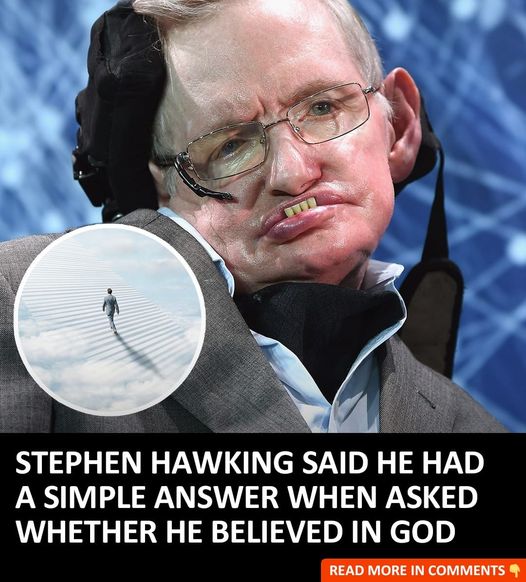
Stephen Hawking shared his opinions on the afterlife before he died. He was a groundbreaking theoretical physicist, and his genius made others interested in his views on God and the afterlife. In multiple interviews and writings, he shared his thoughts on the existence of a higher power and the concept of an afterlife.
The Question of Belief
When asked about his belief in God, Hawking’s response was clear. He believed that there was no proof of a higher power and that the universe could be explained through the laws of science. In an interview with El Mundo, a Spanish newspaper, he stated, “Before we understand science, it is natural to believe that God created the universe. But now science offers a more convincing explanation.”1 Hawking’s views on religion were not limited to a single religion. He believed that all religions were based on the same principles of faith and did not offer any factual evidence. He is, for all intents and purposes, an atheist.
The Grand Design
In his book, “The Grand Design,” co-authored with Leonard Mlodinow, Hawking went further into his beliefs on the universe’s origins. He argued that the laws of physics, rather than a divine creator, were responsible for the creation of the universe. He wrote, “Because there is a law such as gravity, the universe can and will create itself from nothing. Spontaneous creation is the reason there is something rather than nothing, why the universe exists, why we exist.”2
No Afterlife
Hawking’s views on the afterlife were similarly grounded in science. He believed that the concept of an afterlife was nothing more than wishful thinking. In his final book, “Brief Answers to the Big Questions,” he wrote,
“No one created the universe and no one directs our fate. This leads me to a profound realization, there’s probably no Heaven and no afterlife, either…I think belief in an afterlife is just wishful thinking. There is no reliable evidence for it, and it flies in the face of everything we know in science.”3
That said, Hawking does not dismiss anyone else’s beliefs to impose his own. “We are each free to believe what we want and it’s my view that the simplest explanation is there is no God,” he explained.
Conclusion
Stephen Hawking’s views on God and religion were shaped by his experiences as a mathematician and his dedication to understanding the universe through the laws of physics. While his beliefs may have differed from others, his contributions to science will continue to be celebrated and remembered for years to come.